Background
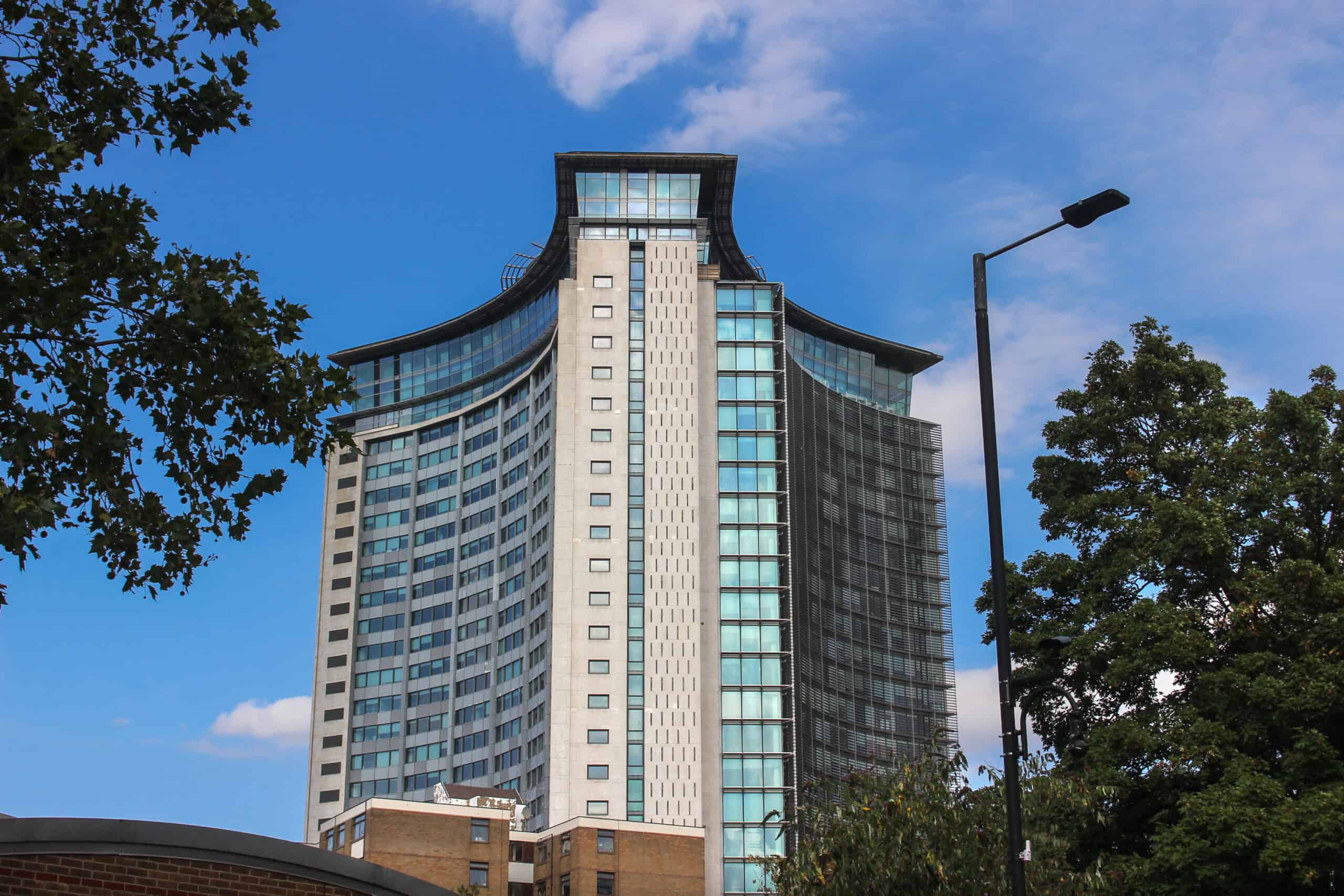
Originally designed as a hotel, the Empress State Building was built between 1958 and 1961, sited on the former Empress Hall in Earls Court.
At 28 floors high, Empress State Building was briefly London’s tallest commercial building. It has been home to the Admiralty, GCHQ and TfL and is now occupied by the Metropolitan Police.
The building is served by six high rise and six low rise passenger lifts, in addition to three individual fire fighter’s lifts.
Brief
Having undergone a modernisation to align it to 21st Century workspace and to accommodate particular facilities required by the police, SVM Associates were appointed to carry out technical feasibility studies to the existing lifts (consisting of original Otis DC machines) to determine requirements for:
- traffic handling
- safety upgrades
- enhanced accessibility
- extended lifecycle
Challenges
Our studies showed us, that in order to satisfy the occupation density, the rated speeds of all passenger lifts had to increase to 3.5m/s for the low rise and 5.0m/s for the high rise.
It would also be necessary to replace the controls with a hall call destination system.
Additional safety features, like anti-rebound compensating pulleys, also required bespoke engineered due to the necessary increase in speeds for occupation density.
Engineering challenges included strengthening of the motor room floor, the use of thermal lances to remove the old equipment and installation of entirely new lift cars.
Process
Our design solutions:
- improved access to machinery spaces
- introduced efficient AC gearless machines
- upgraded the single lifts to current fire fighter’s specification
- incorporated all current safety features
Our specification was used by the main contractor to tender the works to a shortlist of specialist contractors who had been identified by us as suitable contenders.
We were involved in overseeing all phases of the works including handover.
Outcome
The c£7m project was awarded and commenced in January 2020, completing in May 2022.
The project was completed on time despite pandemic restrictions and the understandably tight security protocols.
The building now benefits from high performing, state of the art lifts using open-sourced equipment, extending the lift lifecycle by 20 years.