How do you manage a lift survey and installation when you can’t get access to, or view, the lift shaft? With the help of a high-tech drone is how!
We were commissioned to oversee the installation of a new lift in an old vacant lift shaft. The shaft in question was completely bricked up, finished with plasterboard, and had been left vacant since the building was constructed in 2013 making a lift survey extremely problematic.
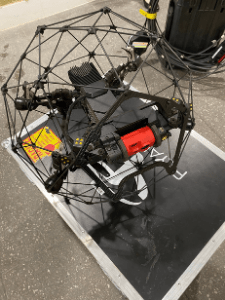 As part of our usual due diligence, we recommended a full structural survey of the lift shaft to confirm its integrity (and ensure that it would be able to withstand the forces of the intended design). We also needed to confirm the shaft constraints; what may have been left in the shaft post-construction and how deep the pit was as the structural drawings required were unavailable.
Usually, the type of survey would be carried out by a Structural Engineer who, in order to access the shaft, would need a scaffold and platform at each landing entrance (with each entrance opened up individually). As this is a 5/6 storey shaft, our client costs were spiraling. A different strategy was necessary.
 After conducting some research, we proposed an innovative shaft survey approach. To create one small opening at the lowest landing and use a specialist drone to survey the shaft via video feedback. The footage would then be reviewed by a structural engineer as a desktop exercise. Our client, as enamored with the concept as we were, agreed excitedly and instructed us to proceed.
As you can see from the videos and photos, the survey was meticulous and the drone pilot was able to direct the drone precisely to the areas we needed to view. The drone survey also saved a great deal of time. In comparison to a traditional ‘manned’ lift shaft survey, it was also considerably safer than a surveyor actually entering the shaft at every floor and much more cost-effective.
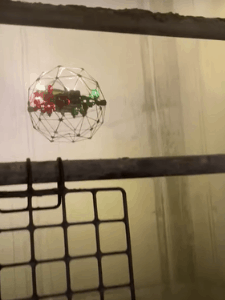 Carrying out the survey by drone saved our client 60% of the original cost of opening up the many entrances required and erecting scaffolding. Cost, however, was not the only benefit. The precision of the drone footage, and the fact it could be rewound, paused, and zoomed, meant the drone was able to cover the inspection on a whole different level; both in terms of accessibility and what can be observed by the naked eye.
The drone was roughly 400mm in diameter and height and had its own football-style roll cage to help it bump off obstacles. Unsurprisingly, a piece of kit like this comes at a price. Valued at over £45k we were relieved that in a lift shaft, it was unlikely to get lost!
We’ve all seen aerial drone footage and a quick Google search will highlight the many uses a drone can have. We consider our first steps into lift survey by drone to be a major success (and certainly a more cost-effective approach for our client).
 We would like to say a big thank you to our clients at