How do we help our clients to reduce carbon emissions?
In December 2020, the Prime Minister set a 2050 target to achieve Net Zero Carbon Emissions in the UK and a decrease of at least 68% by 2030 when compared to 1990 levels.
According to GOV.uk, the UK’s targets to tackle climate change are among the most challenging in the world and represent a firm commitment to reduce carbon emissions.
Of course, we all want to contribute but, as engineering and building consultants, what part can SVMA play?
Our clients have reacted swiftly to the need for change and several have published statements on Net Zero Carbon Emission commitments. A recent commission included CAT A refurbishments at a client’s request to target zero carbon emissions and energy-efficient solutions for heating and cooling.
How can SVMA achieve such high carbon emissions goals?
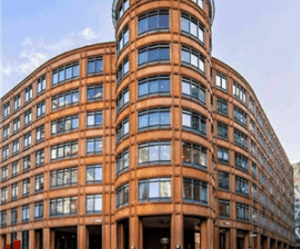
We are fortunate to count British Land as a client and welcomed the opportunity to work on an MEP project at Broadwalk House in the City of London.
British Land’s commitment to sustainability is clear. On their website. they confirm their ‘journey to operational net zero carbon’ and a target to reduce carbon emissions to 500kgCO₂e by 2030.
In line with this commitment, we were asked to research energy-saving options for the replacement of one of three large water-cooled chillers that had come to the end of its economically useful life.
We investigated various technologies and manufacturers, many of which yielded energy saving to some degree, but we felt that more could be achieved. In the end, we were able to save the carbon emissions equivalent to driving an average diesel car for 650,000 kilometers. To give you some perspective, the moon is only 384,400 kilometers away which is quite a saving!
So, how did we achieve such a huge reduction in carbon emissions?
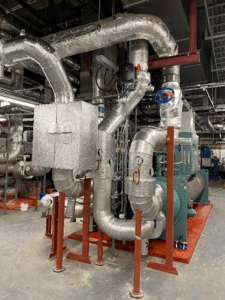 A new type of highly efficient screw chiller was available and would be the first of its kind installed in the UK. The combination of the new, screw compressor technology and the use of a low Global Warming Potential (GWP) refrigerant promised a Seasonal Energy Efficiency Ratio (SEER) in excess of 9.08 – almost twice as energy-efficient as the plant it was replacing!
As with all large plant replacement, careful project planning was needed (especially as the chiller was physically larger than its predecessor). Access to the plant room meant loading tightly curved concrete vehicle ramps, navigating low headroom on route, and breaking out doorways. Despite this, the project was delivered on time, to an excellent standard of workmanship, and even coming in slightly under budget.

The new chiller is now yielding savings of around £70k per year.
Most importantly 117,771kgCO₂e carbon emissions are saved every year – that’s driving an average diesel car almost to the moon and back!
To find out more, read our full case study.
If you and your organisation are committed to a cleaner future contact us today to discuss how we can help you achieve your environmental goals (or exceed them!). There really is no time like the present.