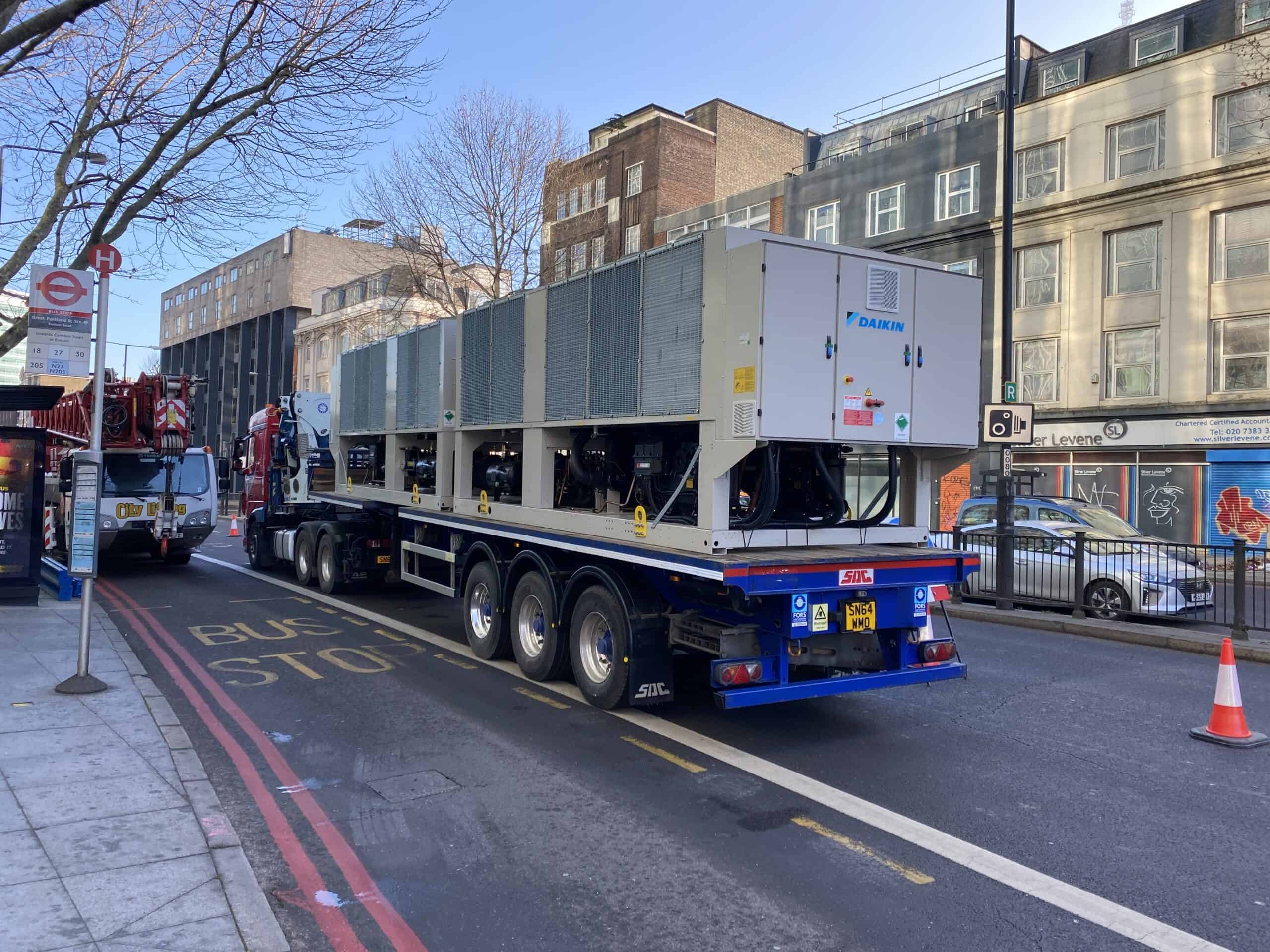
From our recent LinkedIn posts you may think that we are a little over interested in cranes – we don’t deny this. Who hasn’t stopped and watched a crane in action or wondered how the first-ever crane was erected?
However, we have a professional interest too.
Many of our MEP and lift projects require the movement of large plant and equipment and, particularly for clients with city-centre buildings, installation can be a problem.
For MEP plant, such as heating and cooling pumps and chillers, the size of the equipment and the rooftop location means there is no alternative but to use a crane and lift the equipment into place.
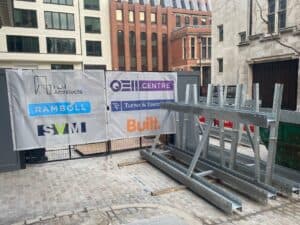
QEII Centre – Westminster
It is quite unusual to use a crane to install lift equipment, however, the external lift being installed in Westminster is unusual in many respects and, although installation has only just started, a 70-tonne crane was needed just to install the guide towers.
Euston Road – London
Even bigger cranes were needed for our two recent MEP projects in London. As you can imagine, planning starts weeks (or months) in advance. If your project is going to close the Euston Road to traffic, nothing can go wrong!
With road closure permits in place, contractors organised, equipment delivered and the 100-tonne lift erected the installation can begin – or can it?

Wind speed is a critical risk factor in crane use and so the nautical good luck phrase ‘fair wind and a following sea’ is apt! If wind speed is excessive, the lifting project must be aborted at high cost and client irritation because the whole process has to be started again.
So, we have the ‘fair wind’, the contractors, the equipment and of course, the crane – what next?
With high levels of co-ordination (and a lot of walkie talkies) the old equipment is removed, and the new equipment put in place. Accuracy and control are vital as there is a risk both to life and the very expensive plant being installed.
At the end of two long days, both MEP projects were completed successfully and without incident.
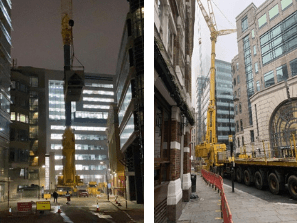
City of London
In the City of London, a new simultaneous heating/cooling heat pump was installed. This delivers 677(kW) of cooling and 590(kW) of heating at the same time and minimises the natural gas usage in the building – critical cooling and space heating provided by the same unit at the same time.
Euston Road – London
On the (usually) busy Euston Road, two heating and cooling heat pumps were lifted into place. When complete, the project will deliver 1,400 (kW) of cooling and 650 (kW) of heating and minimise the use of gas.
(Click on the images below to see Euston Road as you have never seen it before!)